
Silverado - Part 1
There are decades where nothing happens, and there are weeks when everyone posts the same Tyson quote.

A three-part story on the silver exuberance, how everything is not the same but cyclical and why being punched in the face is probably quite healthy.
Warning Letter from 1620
Distinguished Excellencies,
I write to you from a city that has become the envy of the whole world. A place that was a land for sheep 80 years ago and that now believes it has conquered Time. Every week, tons of silver leave from here to travel to come to Spain to make the Kingdom richer and more prosperous. Silver that has made our Kingdom the most pious, our court etiquette the most refined, and our King’s decrees reach across the oceans. And yet, I write to warn you: The silver is a ghost.
I see in your modern “Directives” and “Frameworks” the very same fever that has gripped my Spain. You believe that because you control the market, you control the fabric of reality. We made the same mistake. We thought that by possessing the medium of exchange, we could dictate the terms of existence. That mistake is proving to be fatal for us.
Allow me to share the three shadows that now fall over the Kingdom, which I fear are beginning to darken your own halls:
I. The Architecture of the Sunset
We have a law for everything. We have “Purity Decrees” to ensure only the right people trade, and “Price Edicts” to ensure the bread is cheap. We have created Citadels of Compliance where honest merchants are strangled by parchment. To move a single crate of silk, I must provide a mountain of “proofs.” Meanwhile, the Dutch, who have no such vanities, simply move the silk.
My Warning: You seek to “regulate” the future of intelligence and the breath of the world. You believe that a perfect rule creates a perfect world. It does not. It only creates a world where the lawyer is more valuable than the engineer.
II. The Illusion of the “Unique Market”
Our King believes that because the world must come to Spain for silver, the world will accept any tax, any delay, and any dogma we impose. But our silver merely passes through our hands like water to pay for French grain and English wool. We have become a “Pass-through Empire.” We own the “Standards,” but we no longer own the Tools. The world did not submit; it has bypassed us.
My Warning: You believe the world must follow your “standard” because your market is rich. But if the cost of your “standard” is too high, the world will simply build a new market elsewhere. You will find yourselves with the most ethical rules in a room where no one else is standing.
III. The Memorial of the Useful Policy
We spend our days debating the “Moral Purity” of our silver, while our shipyards rot. We have forgotten how to build; we only know how to audit. We are hollowed out. We have the most magnificent “Principles” in Christendom, but we can no longer feed our own people without Dutch ships.
My Warning: If you continue to prioritize the Protection of your standards over the Creation of new industries, you will achieve your goal: You will have the “Purest” and “Safest” economy in history. It will also be the quietest.
Excellencies, do not mistake activity for productivity. A thousand scribes cannot do the work of one innovator with a free hand. We in Spain have plenty of silver now, and yet we are poor. The Galleons are still coming, but the empire is already gone.
With Grave Concern,
Francisco de Borja y Aragón, Count of Rebolledo and Prince of Esquilache
Viceroy de Alto Perú, Kingdom of Spain
Potosí, 21.03.1626
El Dorado’s Silver Twin and the Alchemist’s Delusion
Francisco de Borja y Aragón was the governor of Potosí, a “geological accident” that after the discovery of vast silver deposits in the nearby mountain, then named Cerro Rico (Rich Mountain), became one of the world’s largest and richest cities. At its peak, in the 17th century, Potosí’s silver mines produced an estimated 60% of all silver mined in the world. Its silver funded the Spanish Empire and fuelled global trade, connecting the mines of the Andes directly to Europe and even to China via the Manila Galleons.
Francisco served as the 12th Viceroy of Peru from 1615 to 1621. During his tenure as viceroy, the city of Potosí kept growing, benefitting from the investments made by his predecessor, Francisco de Toledo, 30 years prior. The search for El Dorado was not something of interest for Francisco. He had inherited a hyper-productive machine that was channelling a record amount of silver back to the Spain and yet, the kingdom’s hunger for silver was bottomless.
Francisco quickly realised that the silver he was sending back to Spain didn’t stay in Spain. It landed in Seville, paused for a moment, and then was sent to the banks of Amsterdam and London to pay for the goods Spain could no longer produce. King Philip III issued multiple decrees that treated silver like a permanent miracle. He used it to fund “The Grand Project”, a series of endless, righteous wars to unify the continent under one faith. He thought the silver made him strong. In reality, the silver was a solvent. It dissolved the muscles of his own economy because he had made “having money” more important than “making things.”
The Kingdom believed they had discovered the magic formula. They did not need to worry about his farmers’ dusty ploughs, about expelling cheap labour or about buying ships and shipbuilding materials from their enemies. They had silver they could use to buy those things. It exported bullion and imported capacity. The empire’s bloodstream ended up growing someone else’s muscles.
For Spain, the inflow of silver looked like effortless power. It made war possible at scale. It made court grandeur feel sustainable. It made promises cheap. But silver did something more insidious than fuel spending: it rearranged incentives inside the empire. It created an environment where underlying vulnerabilities—fiscal overextension, war commitments, weak domestic industry—could persist longer than they should have. It allowed Spain to finance the present at the expense of the future. And when the flow of easy wealth became volatile, the empire discovered it had not built enough of its own resilience to adapt.
As silver was flowing out of the kingdom, king Philip III decided to solve internal problems by minting the vellón, a debased copper coinage. As Spain issued more copper vellón to cover its debts, the coins became worthless. People stopped trusting the face value of the coin and started measuring the actual weight.
The Arbitrista
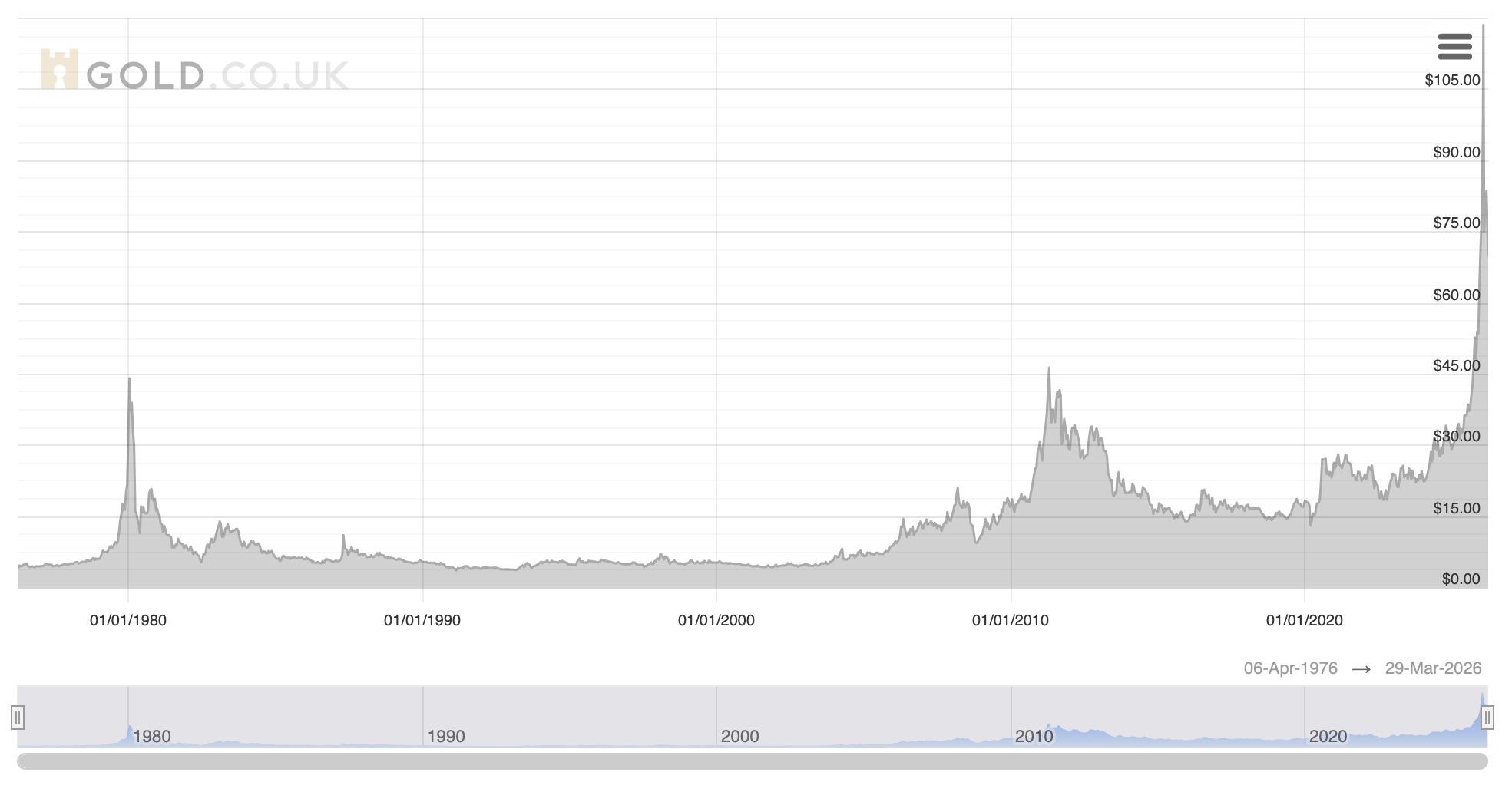
It’s 2026 and a few weeks ago the price of silver touched the highest level of the past decades. However, there’s no sign of inflation (yet) though this renewed energy crisis might change this quite soon. But this is not a story about inflation, nor a story about silver. This is a story about lessons not learnt.
Let’s replace silver with something the European Union is genuinely world-leader: regulation. The EU’s great institutional superpower has been its ability to set norms. Sometimes so effectively that the rest of the world was forced to adapt around them until a few years ago. The EU thought it could be the world’s middleman: when global institutions seemed to work, Europe was safe, highly regulated yet a beautiful place to live. It did not matter that it produced nothing the world needed. Russia provided the fuel, the US provided the software/AI, China provided the hardware, and Europe was fine simply providing the “Terms and Conditions”.
Then history decided that it was time to write a different chapter and we found out that it’s not so easy to be a middleman when the world goes to war, energy becomes a major constraint, and supply-chains are being weaponised for national interests.
And as the Spanish Kingdom did in the 17th century, while the European Union realised it was drowning in its own success, they tasked one “Arbitrista” to produce a series of recommendations on how to fix a stagnating union.
The Arbitristas (literally “projectors” or “those who propose solutions”) were a loose group of Spanish writers, thinkers, and reformers and their primary contribution was pioneering a form of early economic and political analysis that linked symptoms of decline to structural causes. They moved beyond moralizing or purely fiscal complaints to propose systematic reforms aimed at rebuilding Spain’s productive capacity and reducing vulnerabilities.
Martín González de Cellorigo, a lawyer from Burgo, was one of the earliest and most sophisticated arbitristas. In his “Memorial on the Necessary and Useful Policy” he offers a brilliant analysis on:
1. The massive influx of silver as a root cause of the economic distress of Spain which had become rich in “paper” (contracts, censuses, letters of exchange) but poor in real goods
2. The need to promote domestic industry and agriculture over the reliance on imported goods, arguing that true richness comes only from “natural and artificial industry”
3. The need for a complete overhaul of taxes, curb royal expenditure and reduce dependence on foreign bankers (Genoese, Dutch)
Many arbitristas shared overlapping ideas, often compiled in memorials sent to the crown. Spain had many arbitristas who wrote brilliant papers on how to save the empire from inflation; the Kings read them, praised them, and then ordered another expensive war.
And just as the Spanish arbitristas of the 17th century stood before the king and diagnosed why an empire was starving amidst its own silver, 2 years ago Mario Draghi stood before the European Commission and diagnosed why a global regulatory power was stagnating amidst its own standards. Something that was probably summed up in a simple conclusion: “slowing growth has been seen as an inconvenience but not a calamity”.
Two years down the road, another massive global conflict in, and the European Union finds itself reaching the same conclusions once again: Europe is squeezed by high energy prices and high regulatory burden, faces foreign subsidies and import tariffs, and is increasingly dependent on strategic inputs and concentrated supply chains.
The analogy is not “regulation is bad.” Spain wasn’t doomed because it had money. When one tool becomes the default response to every problem, it can crowd out the slower work of building real capacity.
Now the question is no longer whether the EU will try to regulate its way out of the crisis. It will. The question is whether regulation becomes Europe’s silver, a seductive substitute for competitiveness, or a scaffold that helps Europe build capabilities faster than the world is changing.
By 1640, the Spanish Court was the most magnificent in the world. The etiquette was perfect, the religious devotion was absolute, and the legal decrees were beautifully written. But the soldiers had no boots, and the people had no bread.