
The Information Overload
When Iberia went black, social media lit up

In a time of crisis or disruption, social media platforms have become our go-to sources for instant updates and commentary. The recent nationwide blackout in Iberia proved, once again, the key role social media play for both information and interpretation. I resisted the temptation to feed algos but I haven’t managed to restrain myself to pause and reflect on how the convergence of immediacy, ambiguity, and virality can complicate public understanding of major events transforming it into a tribal battle.
Power blackout and..
If you were on holiday in a remote location enjoying some digital detox time or simply disconnecting from the constant overflow of news and notifications, I envy you, and you may benefit from the following recap. If that’s not the case, you can skip the following paragraph and jump directly to the next one.
On April 28th, 2025, Spain and Portugal experienced the first modern blackout. At 12:33, something happened on the grid that triggered a chain reaction, switching off the whole Iberian Peninsula. A blackout at midday on a normal Monday led to the paralysis of transportation systems and widespread disruptions across all services, from hospitals to telecommunications, banking, and so on. An event that is now considered inconceivable in the current European energy market but that, as an Italian, I struggle to classify as “unprecedented” given that Italy experienced something similar no later than 20 years ago. But this is not a piece about the blackout.
..Information overload
The Iberian blackout that forced millions of Spaniards and Portuguese to take the afternoon off and enjoy the sunny day created two parallel phenomena: a technical crisis and an information one. I will skip the first one, just praising the outstanding work done by Red Electrica and REN in bringing the light back on in such a short time and focus on the second crisis. The sudden and extensive nature of the blackout led to an immediate information vacuum, which was quickly filled by social media. As citizens reached for their phones — in the rest of Europe, given that the internet was down in Spain and Portugal — they encountered a digital landscape flooded with real-time updates, unverified claims, exotic theories, and all sorts of expert analysis. Twitter, with its real-time nature, became the primary platform, but already by the late afternoon, you could find extended analysis on LinkedIn. In a matter of few hours, the social media plaza was crowded with a full equipe of electrical engineers that provided all possible explanations around the causes of the blackout.
In no particular order, we went from a cyberattack to sabotage, from atmospheric phenomena to cosmic vibrations, from the instability of renewables to a fire in France, with some observing strange anomalies in Latvia. Here is a short list of the ones I noted down:
Cyberattack: That was the first one that went viral, with a lot of people pointing at Russia, Morocco, and obviously North Korea. Some posts went as far as saying the European Commission accused Russia of orchestrating the attack, which forced the EC to swiftly deny the accusation.
Terrorist Attack and Sabotage: More or less in the same ballpark, the other theory that started to circulate pointed to a terrorist attack and an IT sabotage linked also to some strange events that happened in the previous week. That was quickly dismissed by national authorities.
EMP Strike: Riding the Nord-Stream wave, a rebranded version of it postulated the United States had deployed an electromagnetic pulse (EMP) weapon against the Iberian Peninsula to destabilise the region and send Europe a clear message on the tariff war.
Fire in France: mentions of a fire in the south of France started to spread, with allegations of a damage on the high-voltage line between Perpignan and Narbonne and consequence effect on the Spanish grid. A fire that existed only on Twitter and was later dismissed by RTE.
Atmospheric phenomena: early reports and rumours suggested that an unusual meteorological event (such as a sudden temperature fluctuation) might have triggered the blackout. Media outlets went as far as citing the Portuguese grid operator, REN, as the source of this. The phenomenon was described as "induced atmospheric vibration", causing anomalous oscillations in high-voltage power lines and leading to synchronisation failures across the interconnected European network. As for the cyberattack, REN had to step in and deny the universe was conspiring against them.
Renewable energy: when the first charts of the electricity mix at the time of the blackout starting to circulate, the attention shifted to renewables. That was the time when solar was ramping up and simultaneously gas and other programmable power plants were ramping down. Nothing that the Iberian power system had not experienced before, but something that lots of commentators had been shouting at for years now. Payback time!
Grid oscillations or Technical failure: As the immediate shock of the blackout subsided, more technically focused explanations began to surface, particularly on LinkedIn, where energy experts and energy advocates often engage in professional discourse. By early evening, the third most used tag on social media became #inertia.
Multiple variations on the renewable and technical failure theories continued to emerge throughout the following days, with people coming up with new electromagnetic theories and asking ChatGPT to help them prove their argument, and new ones still being discussed now that more data becomes available, while the Transmission System Operators have already stated they’ve identified the cause. But this is not an article about the possible reasons that generated the blackout. The list above is exhaustive enough to highlight a growing challenge of our connected era: during moments when reliable information is most crucial, we increasingly turn to platforms structurally designed to prioritise engagement over accuracy.
More is less vs less is more vs more or less
Social media's value during emergencies is undeniable. When traditional information channels fail, platforms like Twitter and LinkedIn become essential infrastructure. Over the past two decades, social media have been a key resource for coordination and community support in ways impossible in the past. We’ve seen this multiple times: during the Arab Spring, after the earthquakes in Haiti and the tsunami in Japan, up till the recent Ukrainian conflict. The speed at which social media operate is simply not matchable by traditional news outlets, which end up reverting to social media. Unfair competition.
Yet this comes with a cost. As one scrolled through blackout-related content, genuine insights and conjectures from energy experts appeared alongside speculation about foreign sabotage, meteorological phenomena, and political corruption, all shown with the same authority and confidence. Several viral threads about the blackout's causes were authored by ‘influencers’ with no relevant credentials but massive follower counts that needed to ride the wave to keep being relevant. Feed the algo.
Even more problematic was the urge from academics to join the discourse and present their own theories with no evidence whatsoever yet available. Many could not resist the flight-or-fight instinct to chime in and give their take, confirming their own biases against this or that. And eventually, some were quoted by news outlets, forced to say something quick, anything but now.
This dynamic creates a vicious feedback loop: platforms designed to inform end up amplifying confusion, as journalistic caution is replaced by the urgency to publish. In moments of crisis, this cycle ends up fracturing public understanding, replacing clarity with a chaotic patchwork of half-truths and narratives driven more by momentum than fact. And beyond the immediate spread of all sorts of theories and information, the real issue is the consequence of that: the tribalisation of information.
When the truth becomes opinion-based and subject to personal interpretation, facts are sliced and diced to fit pre-existing worldviews and ideological frameworks. During the blackout, different factions on social media interpreted the event to support their own narratives:
The “I told you so” team, which, like the economists that have predicted 42 of the last 3 recessions, was waiting for something like that to blame renewable energy policy;
The diehard renewable team that will defend solar and wind “whatever it takes”;
The Oppenheimerists which never miss a chance to fit nuclear I;
The on-grid team which has been trying to get the needed attention for a while, but timing is not on its side;
The “everything is geopolitics” team which tries to join the dots with events occurred since the 9-11;
The “we will never know the truth” team that will never be convinced there’s an objective truth and “life is 10% what happens to me and 90% how I react to it”
And many other teams that like to play in their own leagues.
This tribalisation isn't casual, it's structural. Social media algorithms recognise that users engage most deeply with content reinforcing existing beliefs and emotional responses. During the blackout, personalised feeds quickly created entirely different realities based on users' prior engagement patterns. We all received an entirely different explanatory framework, personalised to our views. The result is a fractured information landscape where shared understanding becomes impossible. We all witness the same blackout yet now we live in separate realities, each with its own causes, significance, and solutions.
The cost of information overload
The Spanish blackout was brilliantly resolved by the TSOs with great cross-country collaboration between the Spanish, Portuguese, French, and Moroccan system operators. Red Electrica keeps digging into the data to understand better how to tackle this in the future and prevent future disruptions, and the Spanish authorities are working closely to keep monitoring any other external cause that still remains a threat across the entire world.
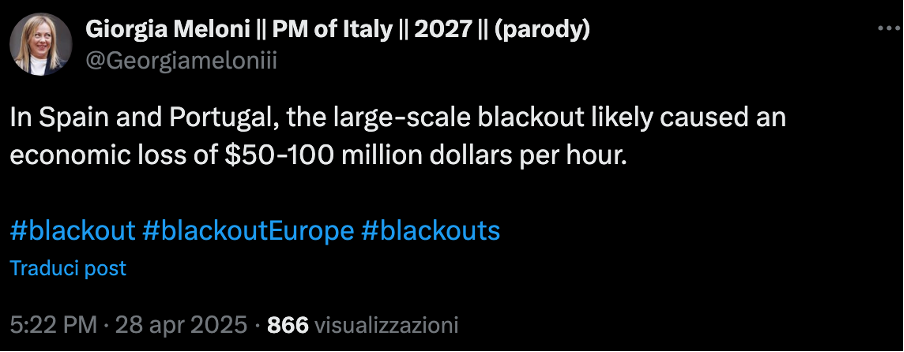
The direct cost linked to the blackout ranges between the 200 million estimated by the parody account of the Italian Prime Minister and € 4.5 billion euros, depending on which tribe you are on.
The indirect toll we face from it is much harder to quantify: the cost of a fractured information ecosystem. When every fact becomes contestable and every expert opinion seems ideologically motivated, as a collective we lose the capacity to form coherent understandings, necessary to generate appropriate responses. The blackout demonstrates once again how quickly a technical event can turn into a wild battleground of competing narratives, each with its own incompatible set of "facts."
Working in the industry and solving that function of providing intelligence and data-driven insights, I’ve been grappling with this short circuit the whole week. It’s not the first time and it won’t be the last one. I won’t add the AI tangent in this, but we all know this is going to get worse before it gets better. As a team that has the luxury of not breaking the news, we have taken a more cautious approach and tried to understand the possible implications of the event, bypassing the “what caused it?” part.
As an individual, I have logged in and off Twitter and LinkedIn at different times, trying to cut through the noise either by making the effort of collecting multiple viewpoints or by simply switching off altogether. And after almost a full week, the best thing I have read comes from David Spence, Professor of Energy Law at UT Austin: “It sucks that we can’t all just learn something from the Iberian blackout. It sucks that every element of it will be weaponised in a fight over the energy transition. There was a time when we all would have taken this event to learn lessons about how to improve the way we manage the grid. But no longer…. I don’t know what we will learn from this, but it sucks that it has to be processed through the prism of partisan or ideological war.”
The other night I went to see the show of an Italian stand-up comedian that I happen to know. He’s gone through different stages in his life and has been criticised for lots of things he said over the years, especially during Covid. While I disagree with some of his views, like all brilliant comedians, he has this uncanny eye for spotting the absurdities and contradictions of modern life and spinning them into jokes. He dove into the whole rabbit hole of conspiracy theories, flat-earthers, fake moon landings, and so on. I won't repeat the specific punchlines, but he masterfully built it all up to a powerful and exasperated question that cut through the noise: "Why is any of that even important?". And this worries me, because if we go back to our inner instinct as human beings, our fight-or-flight instinct, then the only sensible option becomes flight.
(btw, the cover image of a black Iberia is obviously a fake that went viral the day after)